
There is a big difference between “the locate request was sent” and “the information needed for this work has been confirmed.” A calendar reminder cannot close that gap.
Ground disturbance puts planning decisions into contact with things the crew cannot simply see. That makes clear records, complete communication and the right approvals worth more than a confident guess about what is probably underground.
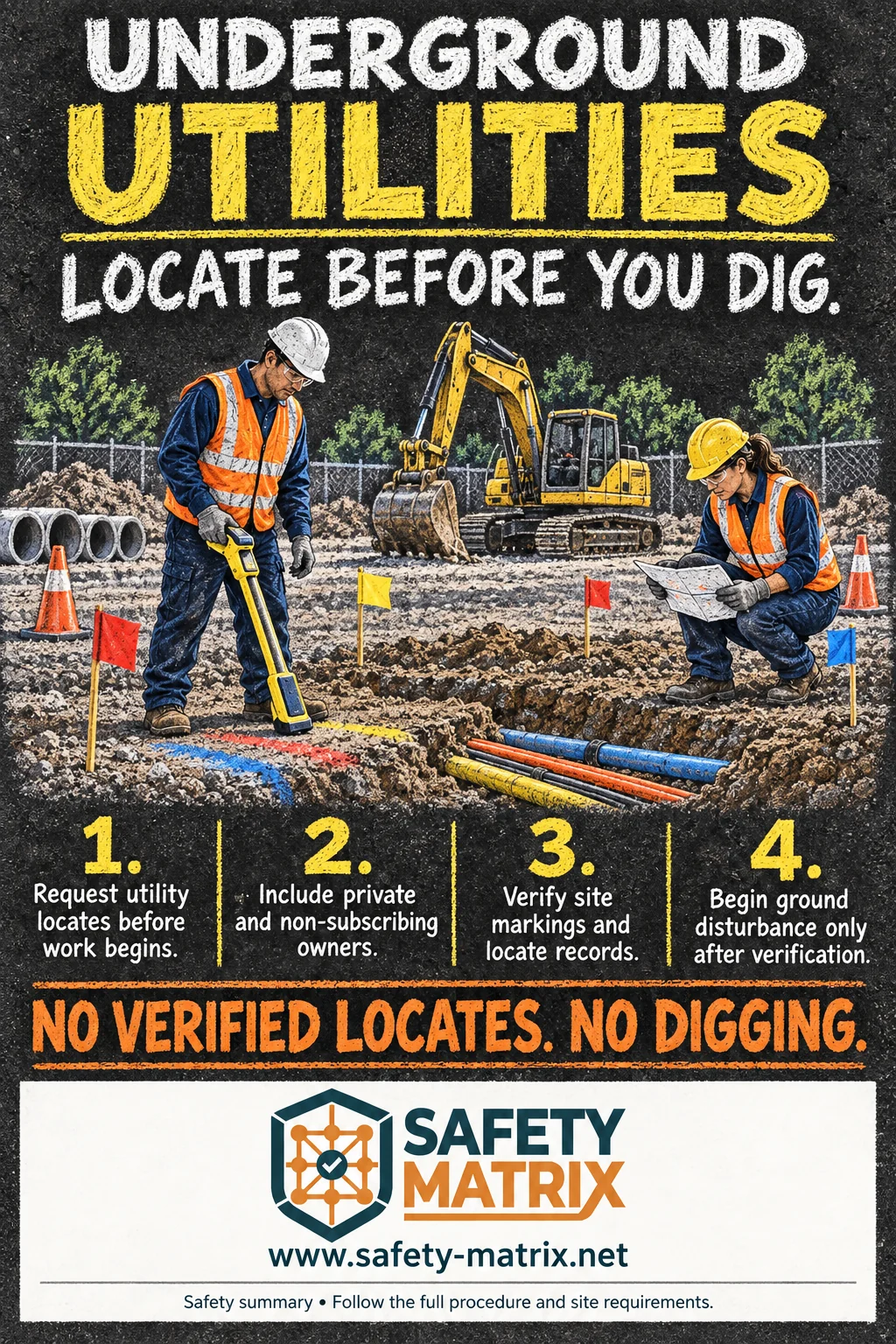
Our underground-utilities poster calls for locates, attention to private and non-subscribing owners, review of records and verification before work. Its message belongs in the planning conversation well before equipment arrives.
A request is the beginning of the conversation
For Saskatchewan work, Sask 1st Call explains that a request notifies affected subscribed members. Excavation must wait for the required member responses, and excavators must also address non-subscribing owners and private lines. Read the service’s locate-request guidance. Other jurisdictions have their own services and requirements.
The management question is who is following that process through. If one person makes the request, another receives the responses and a third schedules the crew, somebody needs to coordinate the complete picture.
Define that responsibility rather than assuming the last person copied on an email has it. The crew should know where the current information comes from and who can resolve a missing response or inconsistency.
Make the work description specific enough to check
“Dig at the east side” may be enough to begin a conversation. It is not necessarily enough to establish that the documents and approvals cover the actual work being proposed.
Have the responsible people review the scope and work area using the site’s approved process. If the task moves or expands, bring that change back for review. Do not treat earlier information as automatic permission for a different job.
The Saskatchewan Common Ground Alliance’s ground-disturbance checklist asks whether markings match records, facility-owner conditions are understood and approvals are in place. It also calls for review when the work scope changes. These are checks for the competent team, not a substitute for its assessment.
Private does not mean unimportant
A site can involve more than the facilities covered by a notification service’s member list. The poster explicitly reminds planners to consider private and non-subscribing owners.
Ask who is gathering the relevant information from the property owner, responsible facility owners and other appropriate contacts. Make unknowns visible. A blank space in a folder should not quietly become a conclusion that there is nothing to address.
This is also a useful procurement conversation. When arranging ground-disturbance work, establish what information each party is providing and who is responsible for confirming the remaining requirements. Leaving that discussion until the machine is waiting creates pressure without improving the evidence.
Give a changed condition a clear route back
Imagine a hypothetical crew arriving to find the planned work area has shifted. The helpful response is to pause and have the responsible person confirm the revised arrangements. The unhelpful response is to ask the operator to judge whether the difference is small enough to ignore.
Follow the applicable ground-disturbance procedure, facility-owner instructions and local requirements. This article gives no excavation method, approach distance or utility-exposure technique. Those decisions require the appropriate training, authorization and site-specific information.
Make sure the crew knows how to raise a discrepancy without being blamed for the resulting review. Finding a planning gap before work starts is useful work.
Five questions for the pre-job discussion
- Who is coordinating all required responses and approvals?
- Does the confirmed information cover today’s actual scope and location?
- How have private and non-subscribing facilities been addressed?
- Who resolves an inconsistency between the records and site conditions?
- What is the reporting route if the work or conditions change?
Keep the supporting information together
Safety Matrix offers controlled company procedures, pre-job hazard assessments and permit workflows. Reviewed toolbox talks help teams discuss the approved approach. It does not locate buried services or approve an excavation.
If your team spends the morning chasing the document that somebody received yesterday, talk to Safety Matrix. We can show you how clearer safety information and follow-through could support the people making the important decisions.