
An empty pallet can achieve surprising longevity when every trade believes it belongs to someone else. Give it another day and it may start receiving mail.
The joke stops being useful when that pallet narrows a route, joins a growing waste pile or encourages somebody to step around it into another hazard. Shared sites need shared expectations, followed by named responsibility.
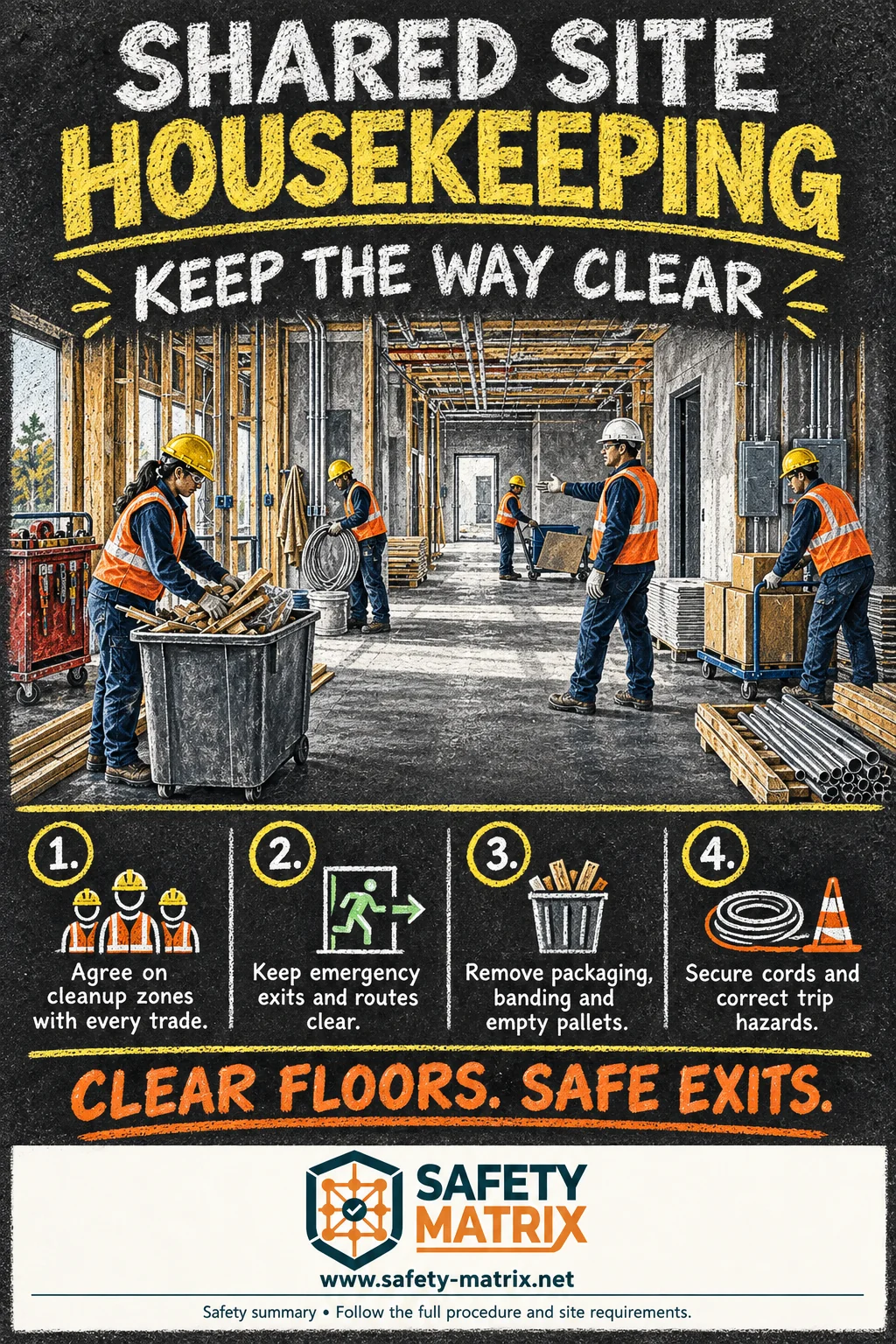
Our multi-trade housekeeping poster focuses on cleanup zones, clear exits, waste removal and trip hazards. These are ordinary jobs. That is exactly why they need to be included in ordinary planning.
Define the handover between trades
“Leave your area tidy” sounds reasonable until two trades work in the same corridor and a delivery arrives between them. Which area belongs to whom? Who deals with packaging generated by shared materials? Who checks the route after the work moves on?
Discuss those interfaces before the space becomes crowded. Agree who coordinates shared areas and how unresolved concerns reach that person. Individual responsibility still matters, but people should not have to negotiate ownership while standing beside a blocked passage.
Make the arrangement understandable to a newly arrived subcontractor. A site custom passed down through familiarity is not the same as an expectation that has been explained.
Make removal part of the activity
A delivery plan that ends when materials leave the truck is missing a useful question: what happens to the packaging? A work plan that ends when installation finishes may leave the same question about offcuts.
CCOHS recommends planned disposal, designated storage and waste areas, clear passages and keeping cords and hoses out of busy walkways. Its construction-site housekeeping checklist offers a useful starting point for a site-specific discussion.
Ask whether the planned containers and collection arrangements are practical for the work. If the approved disposal point is unavailable or full, workers need a clear way to report the problem and get an appropriate alternative arranged.
The purpose is not to invent a more elaborate cleaning campaign. It is to stop treating waste as a surprise by-product of activities that predictably create it.
An exit is a route, not a storage opportunity
“Only until lunch” does not make an emergency route an acceptable place to store materials. Keep exits and the routes serving them clear in accordance with the site’s plan and applicable requirements.
Consider a hypothetical corridor that is clear during the morning inspection but receives several deliveries before noon. The earlier inspection cannot keep it clear. The daily work arrangement needs to preserve access as activity changes.
Supervisors can ask each crew what would make the route difficult to maintain and resolve those pressures in the delivery and work plan. A repeated obstruction is a reason to examine the arrangement, not simply repeat the same warning more loudly.
Look for the pattern behind the pile
Housekeeping reports become more useful when they describe the location, the obstruction and the activity producing it. “Messy again” communicates frustration. A clear description gives the responsible person something to investigate.
Follow up with the workers who raised the concern. Tell them what changed or why a different arrangement was selected. That closes the conversation and gives the next report a reason to be equally specific.
Bring storage of combustible waste and the site’s fire-prevention arrangements into the discussion with the appropriate responsible people. Waste planning, material storage and emergency access should make sense together.
A short meeting with every trade represented
- Who coordinates housekeeping in each shared area?
- What packaging and waste will today’s work create?
- Are the approved disposal arrangements available and understood?
- How will deliveries preserve the required exits and routes?
- Which repeated obstruction suggests the plan itself needs to change?
Finish with names and decisions. A meeting that concludes “we all need to do better” leaves the pallet with another comfortable afternoon ahead.
Keep ownership visible after the meeting
Safety Matrix connects hazard reports with acknowledgement and corrective-action tracking. A controlled company manual and reviewed toolbox talks help teams keep expectations consistent across the site.
Your supervisors have better things to do than investigate the ancestry of every pile of packaging. Book a Safety Matrix demo and explore a clearer way to record concerns, assign follow-up and keep the conversation moving.