

“It still runs” is a remarkably short maintenance report. It tells you the machine started. It leaves rather a lot out.
Does the guard work properly? Has someone already reported a defect? Is the service overdue? And why does the person handing it over say, “There’s a trick to using that one”?
Construction rewards people who can solve problems. That makes it worth being clear about which problems call for resourcefulness and which call for taking equipment out of service. Keeping a job moving should never depend on someone becoming an expert at working around a defect.
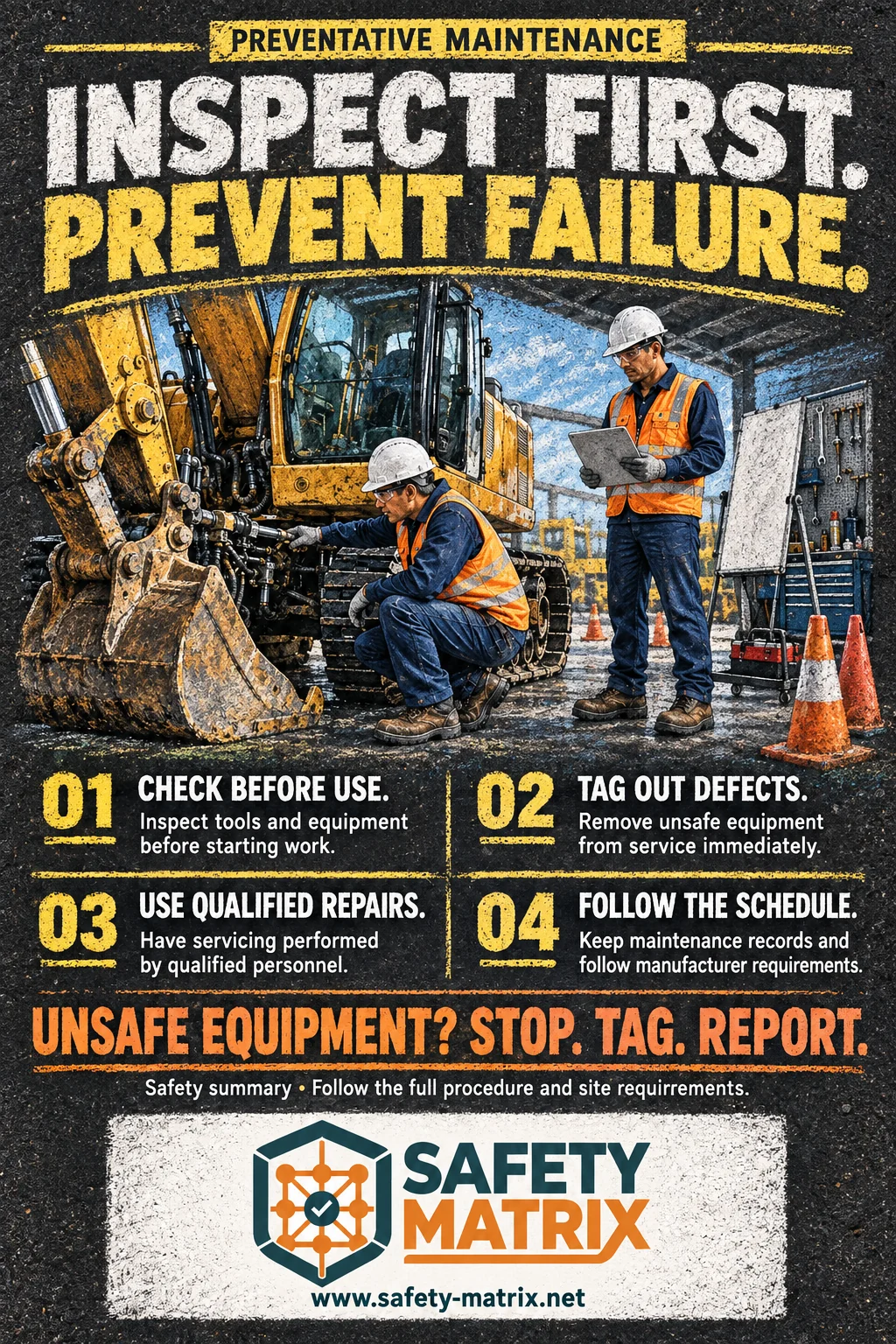
Our preventative maintenance poster gives crews four useful starting points: check before use, tag out defects, use qualified repairs and follow the schedule. The real value comes from making those actions easy to carry out on a busy site.
Familiar equipment still deserves a proper look
Using the same tool every day can make its condition seem like old news. The cracked casing becomes “how it looks.” A damaged switch becomes “how it works.” Familiarity can turn a defect into a story everybody knows and nobody has resolved.
For electric hand tools, CCOHS recommends checking for damage before each use, including defects in the casing, cords, batteries, switches and plugs. Defective tools should be removed from service and clearly identified, with repairs carried out by a qualified person. Follow the manufacturer’s instructions and the training for the equipment. See CCOHS: Electric Tools — Basic Safety.
A supervisor can help by asking for observations that another person can understand. “Drill is acting up” is a starting point. Identifying the tool and describing the faulty switch gives the person responsible for repair something more useful to work with.
Make the defective-equipment route obvious
Ask a new worker what happens after they find a defect. A useful answer should identify who receives the report and how the equipment is kept from being used while the issue is addressed.
If the answer is “put it somewhere near the trailer,” the process needs another look. A defective tool sitting beside usable tools can become somebody else’s next selection.
Consider a hypothetical damaged drill returned to a shared storage area. The worker reports it verbally, but the next shift sees only a drill on a shelf. The gap is in the handoff. A clear identification and removal-from-service process gives the next person information they would otherwise have to guess.
Give the person reporting a defect a clear response and an appropriate alternative plan for the work. That makes raising the concern part of getting the job organized.
A tag communicates; energy isolation protects
The poster’s instruction to tag out defects is a reminder to identify unsafe equipment and stop its use. A warning tag by itself does not isolate hazardous energy or make maintenance safe.
CCOHS explains that lockout involves physical energy isolation under an established procedure. Maintenance can involve stored energy as well as unexpected start-up. Equipment-specific procedures need to address isolation, stored energy, verification and communication. Qualified, authorized personnel must follow the applicable procedure; switching a machine off is not the same as isolating it. Read CCOHS: Lockout/Tag out.
The return to service also belongs in that controlled process. Follow the equipment procedure, manufacturer’s instructions and applicable requirements, including required checks and authorized release. A casual “should be good now” is a poor handover.
Give the schedule a place in the work plan
A maintenance date written somewhere is easy to overlook. Useful planning identifies the equipment, the work due, the person arranging it and what the crew will use while it is unavailable.
The poster calls for keeping maintenance records and following manufacturer requirements. Those records should help the next decision: what was reported, what work was completed and what remains outstanding.
Bring these questions to a toolbox discussion:
- Where do we find the inspection and maintenance instructions for today’s equipment?
- Who receives a defect report, and how is further use prevented?
- Who is qualified and authorized to handle the repair and return to service?
- Which upcoming maintenance needs to be included in our work plan?
Keep the follow-through in view
Safety Matrix brings hazard reports and corrective-action tracking together with a company safety manual with controlled revisions. Your team can also prepare toolbox talks around its procedures, with AI drafts reviewed and approved by people.
We believe a safety system should help the next person act on what the last person found. Bring us your awkward handoffs and your disappearing reports. Book a Safety Matrix demo and see how clearer reporting and follow-through could fit your operation.