
The machine is quiet. The crew is busy. Someone asks whether maintenance is finished, and the answer travels through three people before returning as “probably.”
That is a communication problem no amount of confidence can repair. Equipment status needs a reliable source and an authorized decision, especially when hazardous energy is involved.
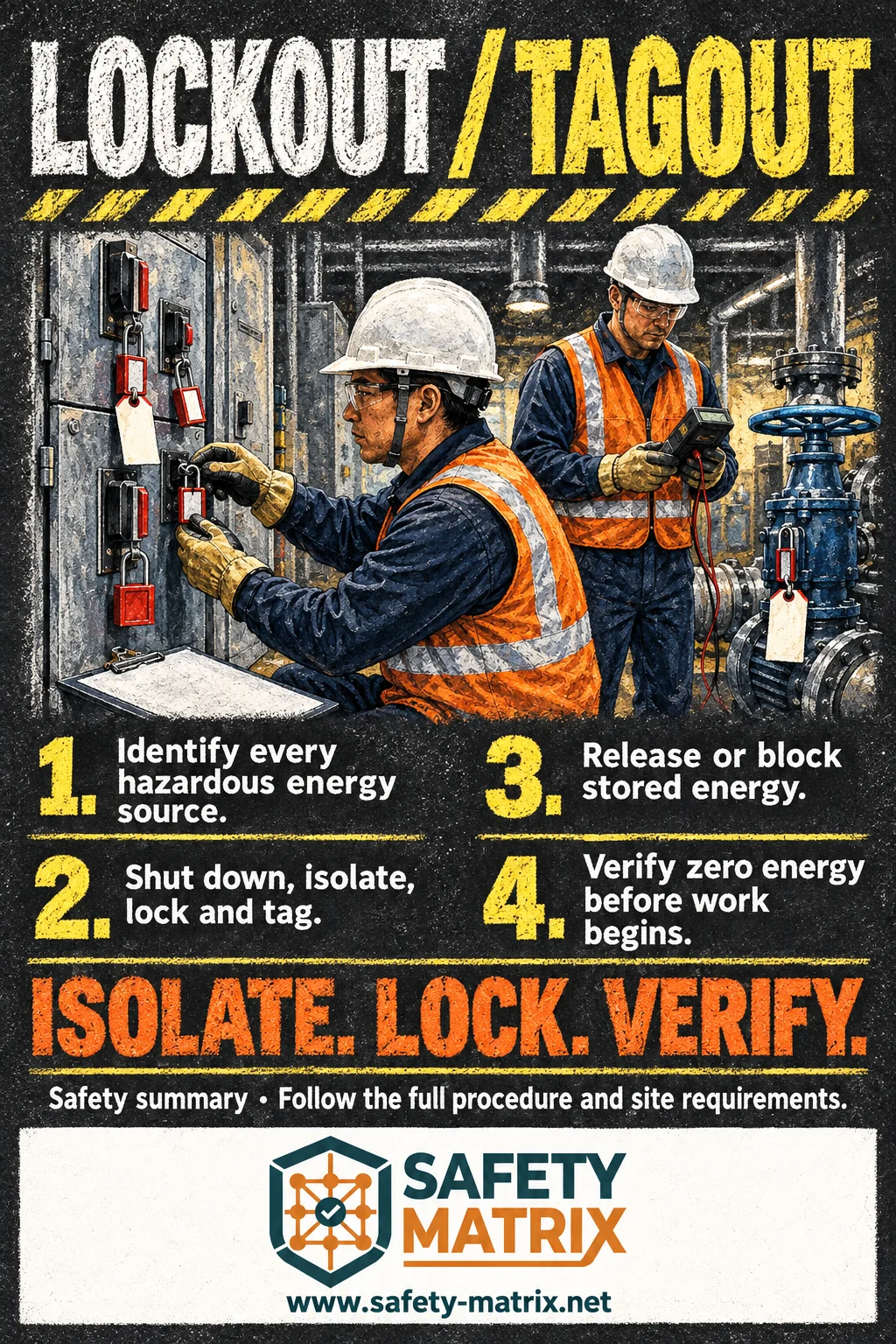
Our lockout/tagout poster is a reminder of the subject’s seriousness. It is not a machine-specific procedure, and its short sequence cannot authorize anyone to perform energy isolation. This article focuses on the coordination that should support the trained people doing that work.
Start with the right understanding of energy
CCOHS explains that hazardous energy includes electrical, mechanical, hydraulic, pneumatic, chemical and thermal sources, among others. Energy may remain stored in a system after its primary supply is isolated. Its Hazardous Energy Control Programs guidance describes the need to address unexpected start-up, motion and stored-energy release through an appropriate control program.
The important distinction for a supervisor is that a machine’s appearance is not its energy-control status. The applicable site and equipment procedures, carried out by qualified and authorized personnel, govern the work. An information tag alone does not isolate energy. Follow the applicable local requirements and the equipment-specific procedure through the site’s hazardous-energy control program.
Give the job a name that survives the handover
“The unit near the back” may make sense to the person who has been beside it all morning. It is less helpful to the incoming supervisor managing several unfinished jobs.
Use the site’s established equipment identification and a clear description of the work scope. The person receiving a handover should not need to reconstruct which machine, contractor or activity the conversation concerns.
Imagine a hypothetical repair that runs beyond a shift change. The incoming team needs the handover required by the approved procedure, not a condensed version passed through someone who was not involved. The scheduling discussion must leave room for that controlled transfer.
Managers can support this by treating coordination time as part of the job. If the work plan allows time to repair equipment but none to hand it over properly, the plan is asking communication to happen by magic.
Do not turn availability into authorization
There is a difference between asking when equipment may be available and deciding that it can be used. The first helps organize work. The second belongs within the authorized process.
A production deadline does not resolve an unanswered maintenance question. Nor does the departure of a contractor tell the next crew that the equipment has been released. Establish who provides the formal status and how that information reaches everyone affected.
Workers should never remove or bypass someone else’s energy controls or attempt to restart locked-out equipment to find out whether it works. Questions about controls, changes, group work or return to service must go to authorized personnel under the applicable procedure.
Keep unresolved matters visible. A note that clearly identifies an outstanding question is more useful than a reassuring message that accidentally erases it.
Test the communication, not the equipment
A supervisor can review the information flow without attempting technical verification. Ask the team to explain who owns the next decision, then compare the answers. Any disagreement is worth resolving before work proceeds.
- How do we identify the equipment and the authorized work scope?
- Who coordinates the affected crews and contractors?
- What handover does the approved procedure require when personnel change?
- Who can confirm equipment status and authorized return to service?
- Where does someone raise an unresolved question without being pressured to guess?
This is a discussion about responsibilities. It is not an isolation, lock-removal or restart checklist.
Make a clear record easier than a rumour
Safety Matrix supports controlled company procedures, hazard reports and corrective-action tracking. Teams can prepare reviewed toolbox talks around their approved practices. The platform supports information and follow-through; it does not perform isolation or certify equipment as safe.
If your handovers currently rely on finding the one person who knows what happened, we should talk. Book a Safety Matrix demo and bring a real example. Clearer responsibilities are a better starting point than another round of “probably.”